

Next.js vs WordPress: Which Should Your Business Choose in 2026?
Rahul Kumar · Technical Lead
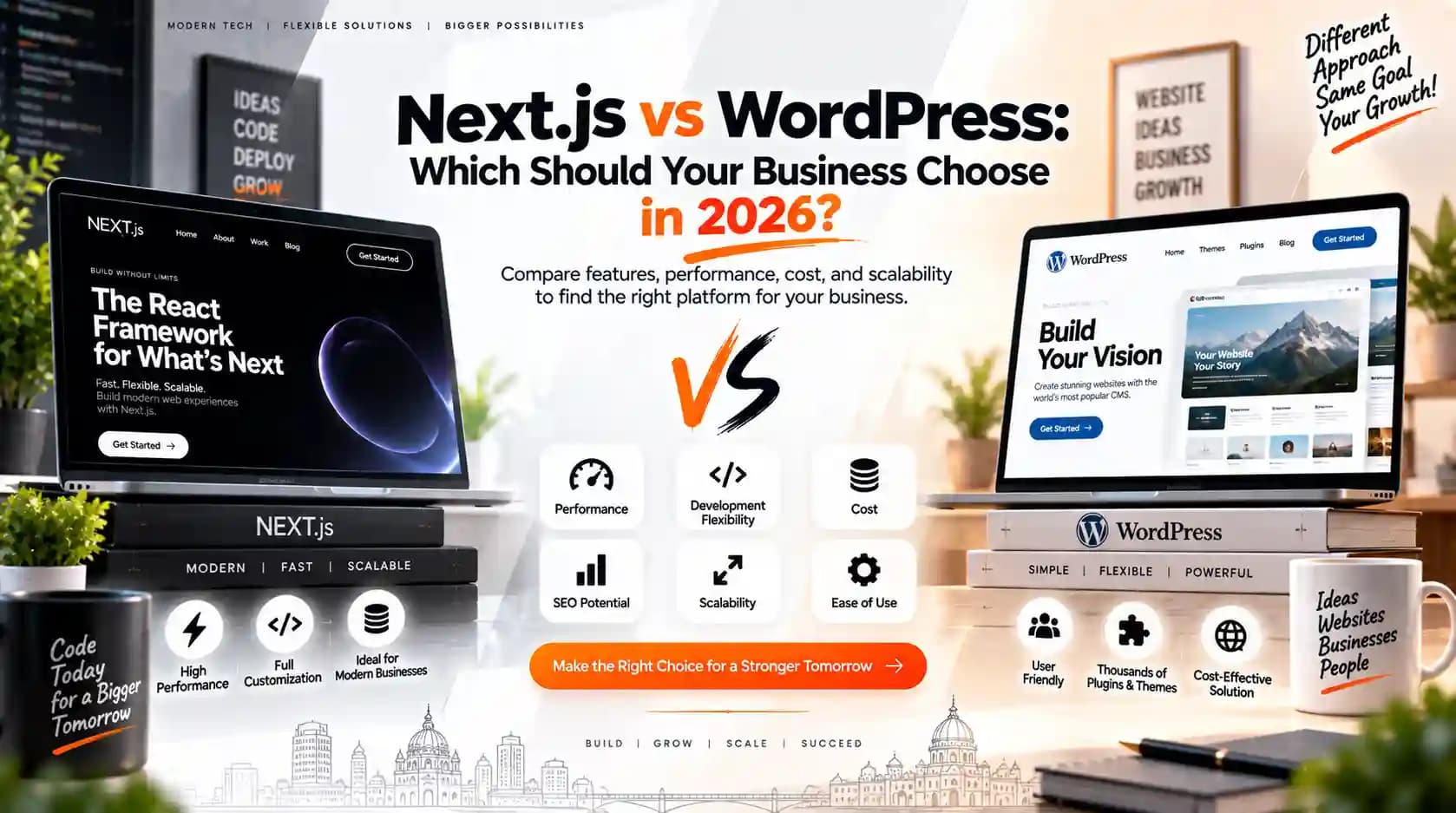
When planning a website rebuild in 2026, business leaders face a pivotal architectural decision: stick with the familiar WordPress ecosystem or invest in a modern, decoupled framework powered by Next.js and React? Both platforms power millions of websites, but they cater to fundamentally different business requirements.
The Core Difference: Monolith vs Modern Decoupled Architecture
WordPress is a traditional monolithic CMS built on PHP and MySQL, rendering pages on the fly through database queries every time a user requests a URL. Next.js, developed by Vercel, is a modern React framework combining static site generation (SSG), server-side rendering (SSR), and edge computing for instantaneous page loads and unmatched security.
1. Speed & Core Web Vitals Performance
Google's Core Web Vitals directly influence organic search rankings and conversion rates. Here is how the two stacks compare:
WordPress: Relies heavily on third-party plugins, complex themes, and database lookups. Without aggressive caching, CDN tuning, and premium hosting, WordPress sites frequently suffer from high Time to First Byte (TTFB) and bloated JavaScript bundles.
Next.js: Pre-renders HTML at build time or on edge servers, serving lightweight, optimized code with automatic image compression and zero unused JavaScript. Next.js applications regularly score 95–100 on Google PageSpeed Insights out of the box.
2. Enterprise Security & Maintenance Overhead
Security vulnerabilities represent WordPress's greatest liability. Over 90% of CMS vulnerabilities stem from outdated plugins, abandoned themes, or insecure database credentials. Maintaining a secure WordPress installation demands constant monitoring, updates, and firewall configurations.
In contrast, a Next.js frontend has no exposed MySQL database or backend administration panel accessible via predictable URLs like /wp-admin. Your static assets are distributed securely across global CDNs, virtually eliminating DDoS vulnerabilities and SQL injection attacks.
3. Custom UI/UX & Application Scalability
If your website is merely a 5-page brochure, WordPress with a clean theme may suffice. However, if your vision encompasses interactive pricing calculators, client portals, real-time booking engines, custom dashboards, or seamless mobile app parity, Next.js is exponentially superior. Building custom React components grants 100% design freedom without plugin limitations.
Which Should Your Business Choose?
Choose WordPress if: You need a basic blog launched overnight, have no engineering budget, and rely solely on non-technical staff to install off-the-shelf plugins.
Choose Next.js if: You demand ultra-fast sub-second loading speeds, enterprise security, custom web application functionality, and elite SEO rankings that give you a commanding edge over competitors.
Custom Next.js Development by Shish Technology
Shish Technology specializes in engineering ultra-fast, bespoke Next.js web applications, headless commerce portals, and modern digital ecosystems designed for sustained business growth. Contact our engineering team today for a free technology stack consultation.
Key takeaways
- WordPress fits editor-heavy sites
- Next.js excels at speed and modern UX
- Choose based on team and roadmap