

How AI Search (SGE) is Changing SEO and Website Traffic in 2026?
Shish Technology · Content Team
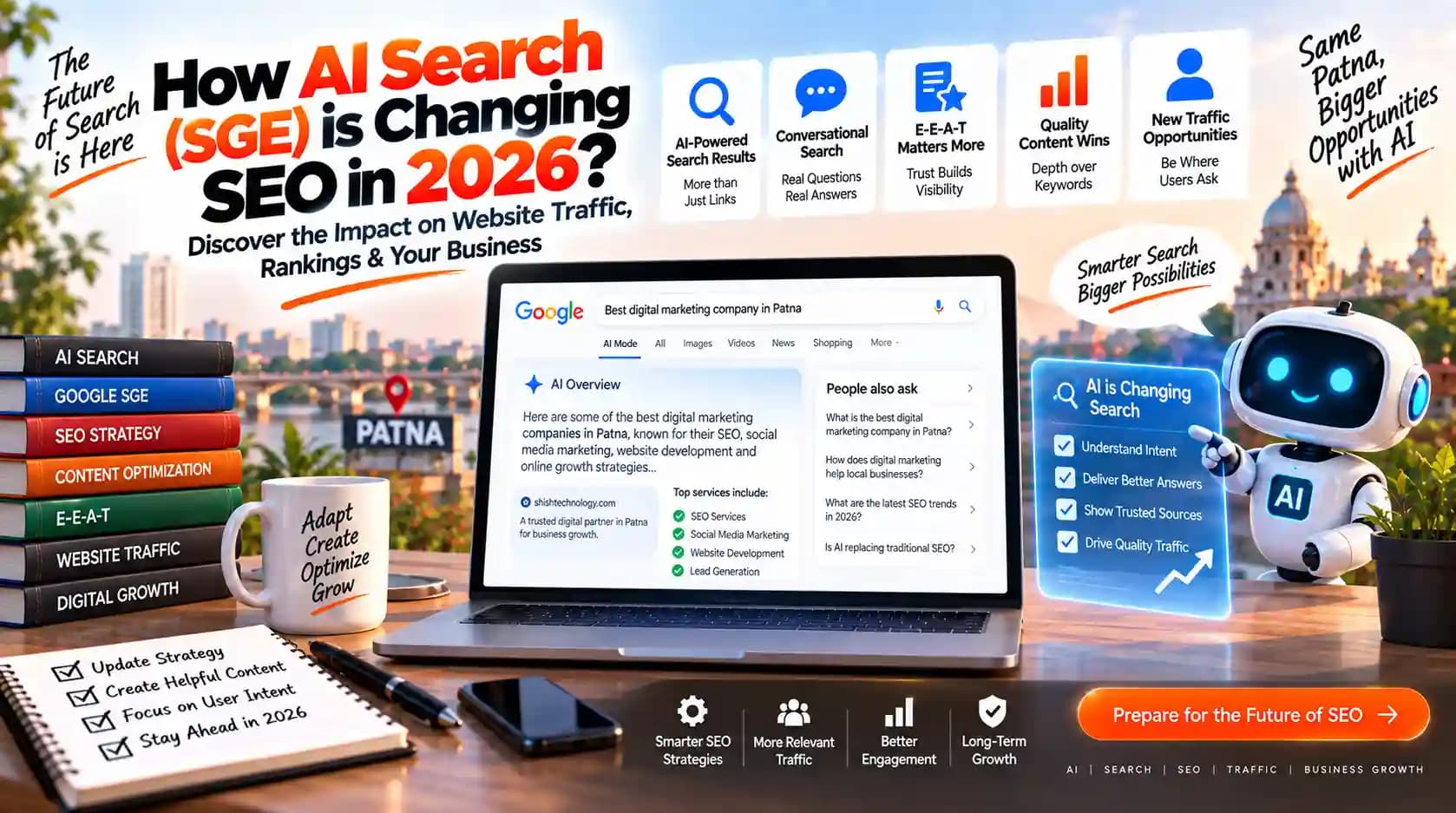
Imagine walking into a library where, instead of searching through rows of dusty shelves, a brilliant assistant greets you at the door, listens to your questions, and hands you the book exactly what you want. This is no longer science fiction; it is the reality of the internet today.
As we move through 2026, the traditional "search engine" has evolved into a sophisticated answer engine, driven by AI search SEO. This shift is fundamentally rewriting the DNA of the digital world, moving us away from a simple list of links toward a future where machines understand human intent better than ever before.
For business owners and creators, this change can feel like the ground is shifting beneath their feet. We are transitioning from an era of "matching keywords" to an era of "matching needs." If your digital presence isn't built to talk back to these intelligent syste
ms, you risk becoming invisible in a landscape where the Search Generative Experience (SGE) is now the primary gatekeeper.
Adapting to SGE SEO optimization isn't just a technical upgrade; it is a total rethink of how you prove your value to the world. It’s about ensuring that when the AI looks for the best answer, it finds your expertise standing front and center.
The Rise of the Generative Answer
In 2026, the standard search results page will be completely redesigned. The "top spot" is no longer just a blue link; it is a rich, AI-generated box that synthesizes information from across the web to give the user an instant solution.
This is the heart of AI search optimization. To win in this environment, your content must be structured so that the AI can easily digest your facts and credit you as a primary source.
If you are the "brain" behind the AI's summary, you gain a level of trust that a standard advertisement could never buy.
Quality Over Quantity in Traffic
There is a common fear that if AI answers, no one will click on the website. However, the data tells a more interesting story.
While "zero-click" searches are common for simple facts (like "What is the capital of France?"), the impact on professional services is different.
When analyzing how AI search affects website traffic in 2026, we see that casual browsers are being replaced by high-intent visitors. A person who reads an AI summary and then clicks your link is deeply interested in your specific expertise.
They aren't just looking for a definition; they are looking for a partner, a product, or a professional solution.
Building Authority and Trust (E-E-A-T)
To stay relevant, you must optimize website for AI search engines by leaning into what makes you human. AI models are now trained to hunt for E-E-A-T—Experience, Expertise, Authority, and Trust.
Real-World Experience: Machines can't go outside. Share photos, case studies, and personal stories that prove you have actually done the work.
Deep Expertise: Avoid surface-level content. Use technical language correctly and provide insights that only a specialist would know.
Verified Trust: Ensure your site has clear authorship, reliable citations, and a strong history of providing accurate information.
The Shish Technology Approach to AI SEO
The technical side of search has become a high-stakes game of "Information Density." Many modern brands are turning to Shish Technology AI SEO to trim the "fluff" from their digital strategies.
In 2026, if a paragraph doesn't add value, it’s just noise that the AI will ignore. The goal is to provide the most helpful information in the shortest possible time.
This streamlined approach ensures that both the search engine's algorithm and the human reader get exactly what they want without having to dig through useless filler text.
Ranking in a Conversational World
Achieving a high AI search ranking now requires a "natural language" mindset. People aren't typing in fragmented code anymore; they are asking their devices full, conversational questions while they cook, drive, or work.
Direct Answer Blocks: Start your articles with a clear, one-to-two-sentence answer to the primary question.
Natural Phrasing: Write as if you are explaining a concept to a friend. If it sounds like a robot wrote it, the AI will likely treat it as low-quality content.
Voice Search Optimization: Ensure your content is easy to read aloud, as voice-activated AI is a massive driver of traffic in 2026.
The Power of Digital Reputation
Modern Google SGE SEO looks far beyond the walls of your own website. The AI is constantly "listening" to what the rest of the internet says about you.
It checks reviews, social media mentions, and news articles to see if you are a recognized leader.
Shish Technology search optimization focuses on building this "off-page" authority. By creating a consistent presence across various platforms, you tell the AI that your brand is a safe and reliable recommendation to make to its users.
The Visual and Multimedia Era
Search is no longer a text-only medium. AI in 2026 can "watch" your videos and "read" your charts to find answers for users. This means the future of SEO is multi-modal.
A high-quality infographic or a 60-second video tutorial can often be more "searchable" than a long-form essay.
By giving the AI different types of media to work with, you increase the chances that your brand will be featured in the most prominent parts of the search result, whether that is a video snippet, an image carousel, or a text summary.
Conclusion
The rise of AI search is not a threat to those who provide real value; it is a massive opportunity to stand out from the noise.
In 2026, the internet is rewarding the experts, the innovators, and the brands that put the user’s needs first.
By focusing on deep authority, conversational clarity, and a strong digital reputation, you can ensure that your website doesn't just survive this change—it leads it.
The tools have changed, but the goal remains the same: being the best possible answer to the world's questions.
Frequently Asked Questions (FAQs)
1. What is AI search SEO, and how is it different from traditional SEO?
Traditional SEO focused on ranking for specific keywords, while AI search SEO focuses on "answer engine optimization."
It is the practice of structuring your content so that AI models can easily parse your information and present it as a direct, summarized answer to a user’s query.
2. How can I optimize my website for AI search engines?
The best way to optimize your website for AI search engines is to focus on E-E-A-T (Experience, Expertise, Authority, and Trust).
3. How do Shish Technology services help improve AI search ranking?
We improve your AI search ranking by focusing on E-E-A-T (Experience, Expertise, Authority, and Trust).
This involves creating human-centric content, such as case studies and unique insights, that machines cannot easily replicate, alongside maintaining a strong technical foundation.